Training for management bodies
Members of management bodies are required to follow training that enables them to identify risks and assess cybersecurity risk-management practices.
Art. 20(2)NIS2 Directive
Directive (EU) 2022/2555 extends mandatory cybersecurity to thousands of European companies and public administrations. It requires risk-management measures, notification of significant incidents in three stages and training for management bodies, which can be held liable.
As of 2 November 2026, French transposition is not complete. The bill on the resilience of critical infrastructure and the strengthening of cybersecurity was adopted by the Senate on 12 March 2025 (Senate legislative file (in French)), then by the special committee of the National Assembly on 10 September 2025. Scheduled for a plenary reading on 7 and 9 October 2026, it was withdrawn from the agenda by the Conference of Presidents on 6 October 2026; no new date has been announced since. On 8 July 2026, the European Commission referred France, Spain, Ireland and the Netherlands to the Court of Justice of the European Union and requested financial penalties (Commission press release).
Since 17 March 2026, ANSSI, France's national cybersecurity agency, which is supporting the transposition, has published the Référentiel Cyber France (ReCyF), which sets out the measures recommended to meet the NIS2 security objectives (cyber.gouv.fr). In Belgium, the law of 26 April 2024 transposes the directive and has applied since 18 October 2024, under the supervision of the Centre for Cybersecurity Belgium.
Who NIS2 applies to
In 18 sectors, the directive covers companies that are at least medium-sized within the meaning of Recommendation 2003/361/EC: 50 or more employees, or annual turnover and balance sheet total above €10 million. Some entities are covered regardless of size. See also healthcare and SMBs and mid-market firms.
| Category | Who | Supervision | Maximum fine under the directive |
|---|---|---|---|
| Essential entities | Large companies in sectors of high criticality (Annex I: energy, transport, banking, health, water, digital infrastructure, ICT service management, public administration, space); certain entities regardless of size | Ex ante and ex post | At least €10 million or 2% of total worldwide annual turnover, whichever is higher |
| Important entities | Medium-sized companies in Annex I sectors; medium-sized and large companies in other critical sectors (Annex II: postal services, waste, chemicals, food, manufacturing, digital providers, research) | Ex post, following evidence of non-compliance | At least €7 million or 1.4% of total worldwide annual turnover, whichever is higher |
Human-factor obligations
Members of management bodies are required to follow training that enables them to identify risks and assess cybersecurity risk-management practices.
Art. 20(2)Member States encourage similar training for employees on a regular basis. Basic cyber hygiene practices and cybersecurity training are among the mandatory measures.
Art. 20 and 21Risk analysis, incident handling, supply chain security, human resources security and access control, multi-factor authentication, assessment of the effectiveness of measures.
Art. 21(2)Management bodies approve the risk-management measures, oversee their implementation and can be held liable for the entity's infringements.
Art. 20(1)Article 21: the ten minimum measures
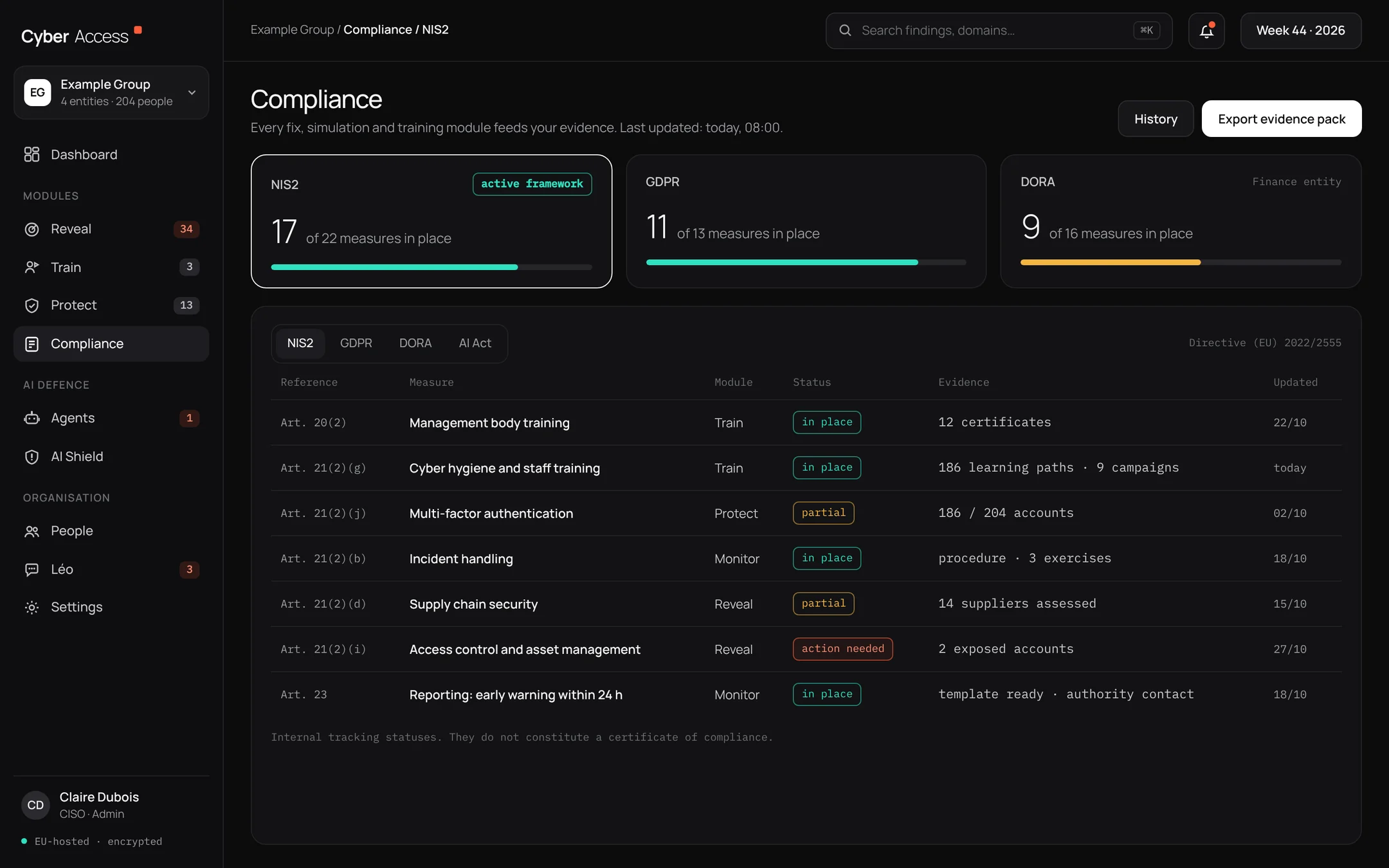
Article 21(2) of the directive sets the baseline of risk-management measures. Cyber Access mainly covers the human side and the evidence; infrastructure measures remain the responsibility of your organisation or your managed service provider.
| Measure (Art. 21(2)) | What Cyber Access provides | Coverage |
|---|---|---|
| (a) Risk analysis and information system security | Mapping of human and technical exposure, linked to the fraud scenarios it makes possible (Reveal) | |
| (b) Incident handling | One-click reporting of attempts, dated history of alerts and fixes (Monitor) | |
| (c) Business continuity and crisis management | Out of scope: backups, disaster recovery plan, crisis exercises | |
| (d) Supply chain security | Training against fake supplier fraud; dated evidence to provide to your in-scope customers | |
| (e) Security in acquisition, development and maintenance | Out of scope: secure development, handling of software vulnerabilities | |
| (f) Assessment of the effectiveness of measures | Risk score, simulation results over time, dated NIS2 reports (Monitor) | |
| (g) Cyber hygiene and cybersecurity training | Simulations based on your real weaknesses, for management and staff (Train) | |
| (h) Cryptography and encryption | Check of your domain configuration: DMARC, MTA-STS, DNSSEC (exposure scan) | |
| (i) Human resources security, access control, asset management | Detection of leaked credentials and exposed accounts; procedures for verifying sensitive requests | |
| (j) Multi-factor authentication, secured communications | Assisted MFA deployment; training against cloned-voice and video-call fraud (Protect) |
CoveredPartially coveredNot covered
Incident handling
The deadlines run from the moment the entity becomes aware of a significant incident, that is, one capable of causing severe operational disruption or financial loss, or of affecting other persons by causing considerable damage (Article 23). In France, notification will be made to ANSSI.
Without undue delay and within 24 hours of becoming aware, the entity sends an early warning to the CSIRT or the competent authority, indicating whether malicious action is suspected.
Within 72 hours of becoming aware: update of the early warning, initial assessment of severity and impact, and any available indicators of compromise.
The CSIRT or the authority may request a report on relevant status updates.
No later than one month after the notification: detailed description, type of threat or root cause, mitigation measures, any cross-border impact.
The directive provides that management bodies can be held liable for infringements of the risk-management measures (Article 20). Member States must also be able to hold liable the natural persons who manage the entity or act as its legal representative, for breach of their duty to ensure compliance with the directive: Article 32(6) provides for this for essential entities, and Article 33(5) extends it to important entities.
As a last resort, where an essential entity fails to remedy its infringements within the time limit set, the authority may request a temporary ban preventing a chief executive or legal representative from exercising managerial responsibilities (Article 32(5)). The full text is available on EUR-Lex.
Cyber Access covers the human side of the Article 21 measures and produces the corresponding records. Technical infrastructure measures and notification remain your responsibility.
Timeline
Directive (EU) 2022/2555 is published in the Official Journal of the European Union; it enters into force on 16 January 2023.
Member States were required to adopt their national measures, applicable from 18 October 2024.
The French ‘resilience’ bill is adopted by the Senate at first reading, under the accelerated procedure.
The special committee of the National Assembly adopts its text.
ANSSI publishes the Référentiel Cyber France, which regulated entities will be able to rely on during an inspection.
The European Commission refers France, Spain, Ireland and the Netherlands to the Court of Justice of the European Union for failure to transpose, with a request for financial penalties.
The Conference of Presidents of the National Assembly withdraws the bill from the agenda of the sittings of 7 and 9 October; no new date has been set at the time of writing.
It is if it operates in one of the 18 listed sectors and is at least medium-sized (50 employees, or turnover and balance sheet above €10 million), or if it falls within a category covered regardless of size. ANSSI's simulator (in French) gives a first indication; the definitive list will depend on the French law and decrees.
The substantive obligations are set by the directive and are not expected to change in nature. Training management, remediating weaknesses and building an evidence history takes months. ANSSI states that future essential and important entities can begin securing their systems now. Our NIS2 guide for SMBs and mid-market firms sets out the priorities.
The directive requires Member States to ensure that members of management bodies follow training (Article 20(2)). In France, the obligation will apply once the transposition law enters into force. For other staff, the directive encourages regular training and includes cybersecurity training among the mandatory measures.
The entity concerned notifies the CSIRT or the competent authority itself; in France, ANSSI. Cyber Access does not notify on your behalf, but the dated history of exposures, alerts and fixes makes it easier to draft the early warning and the final report.
Indirectly. Entities in scope must address the security of their supply chain (Article 21). Their contractual requirements therefore pass down to their suppliers, who must be able to show their own measures.
No. Cyber Access covers the human side of risk management and provides dated NIS2 reports. Compliance also requires technical measures, governance and procedures that are the responsibility of your organisation.
Conversation with an expert
30 minutes with an expert: your weaknesses, the associated simulations and the NIS2 report you will be able to present to your management.