The platform
One cycle, from the weakness found to the fraud prevented.
Cyber Access brings together what the market sells separately: exposure auditing, team training, remediation and monitoring. Each module feeds the next, and everything starts from your real weaknesses.
Why a cycle
An audit that stays in a report protects no one. Neither does generic training. The value lies in the link between the two: the weakness found on Monday becomes Thursday's simulation, then a verified fix the following week.
The platform in pictures
What your teams see, every morning.
Screens from the Cyber Access platform, shown on a fictitious organisation. Each view is designed for a specific audience: leadership, security, finance teams.
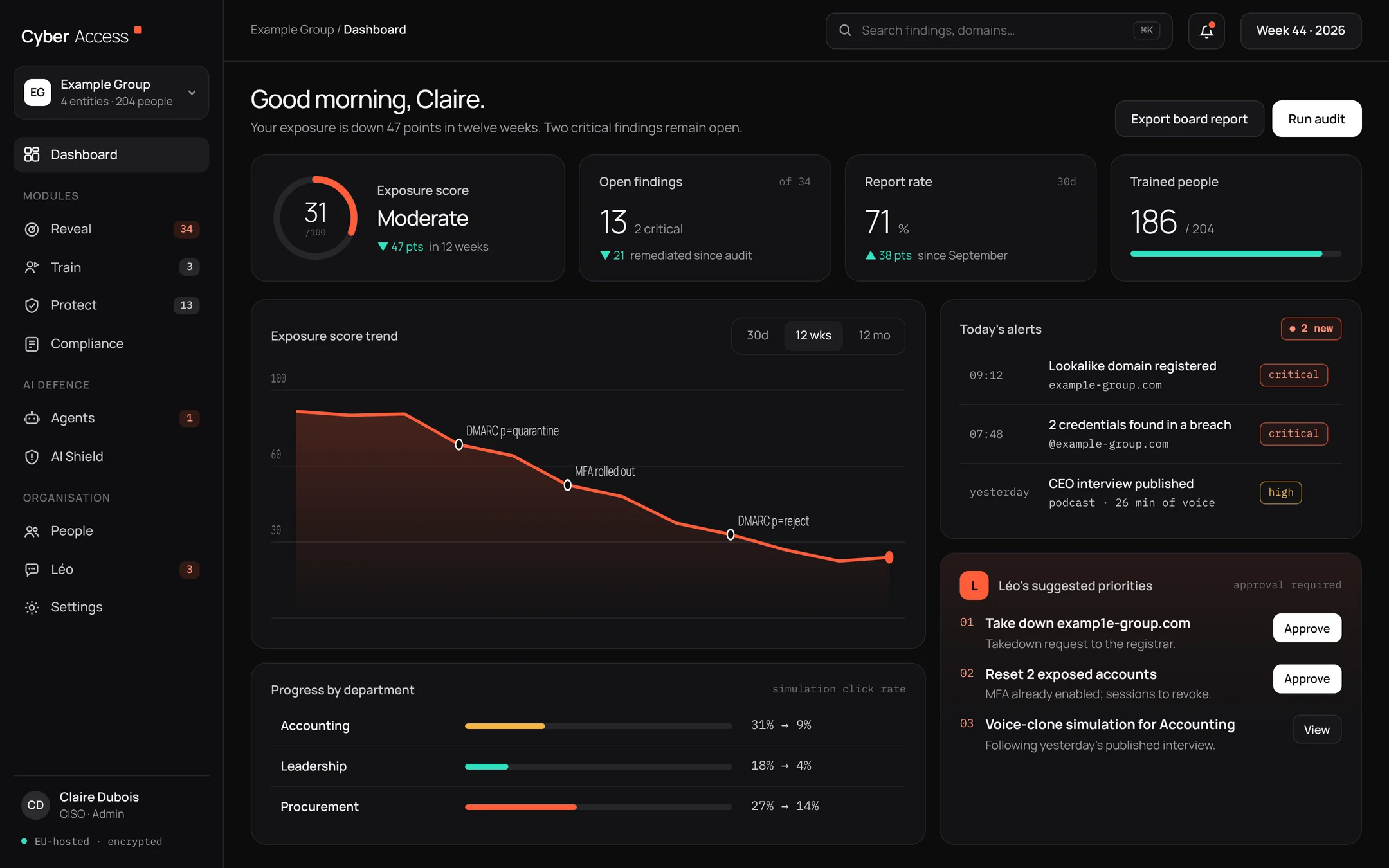
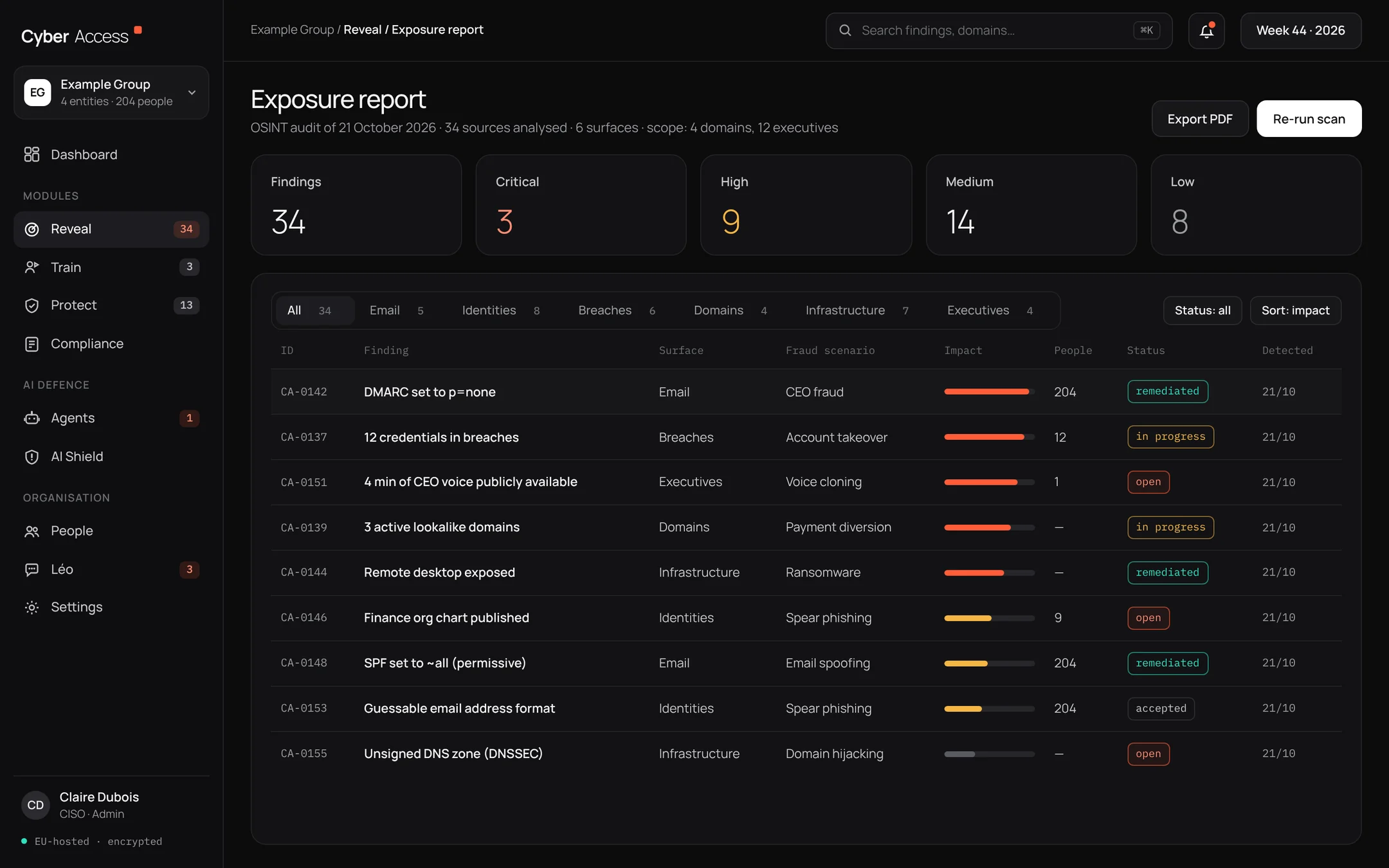
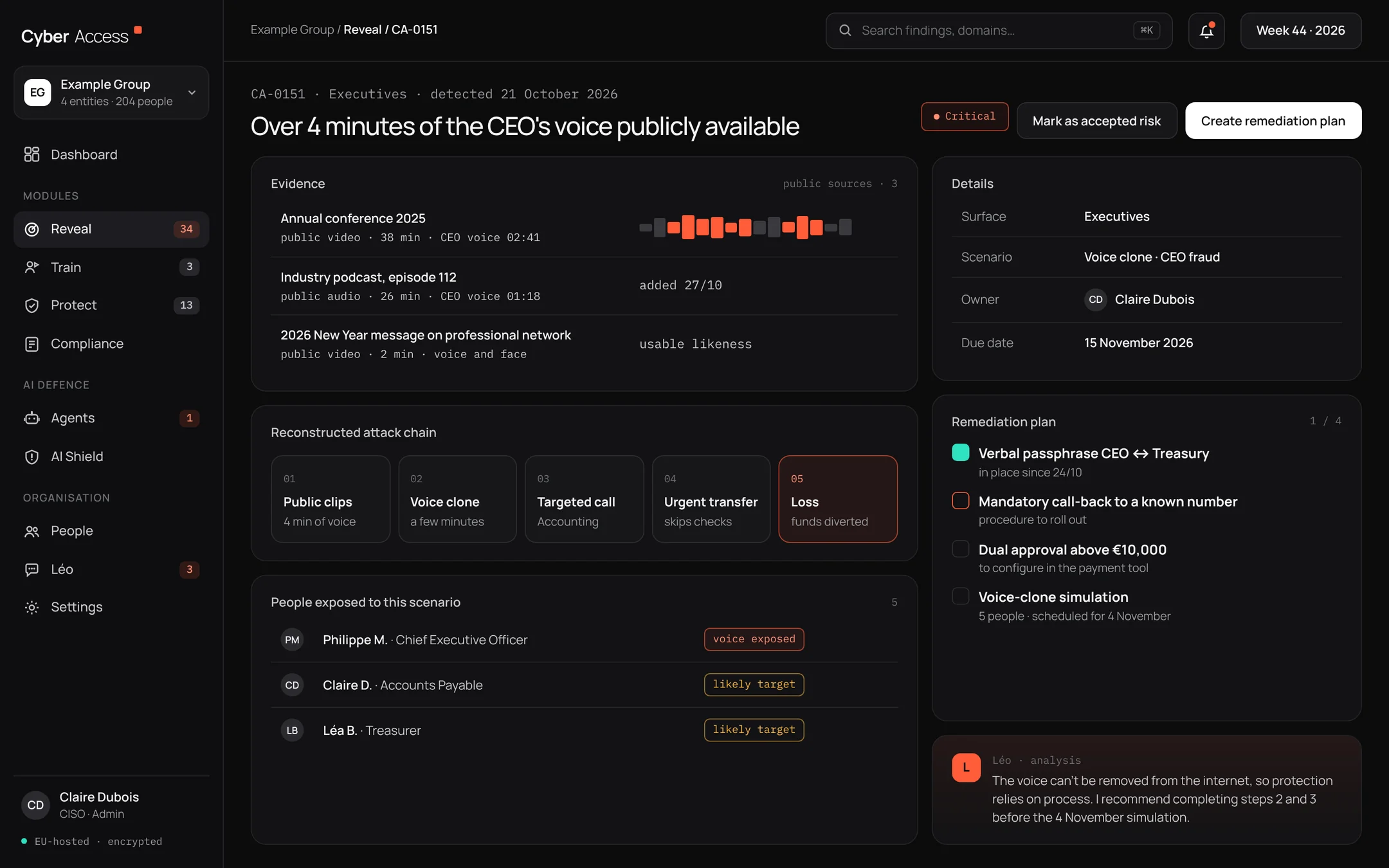
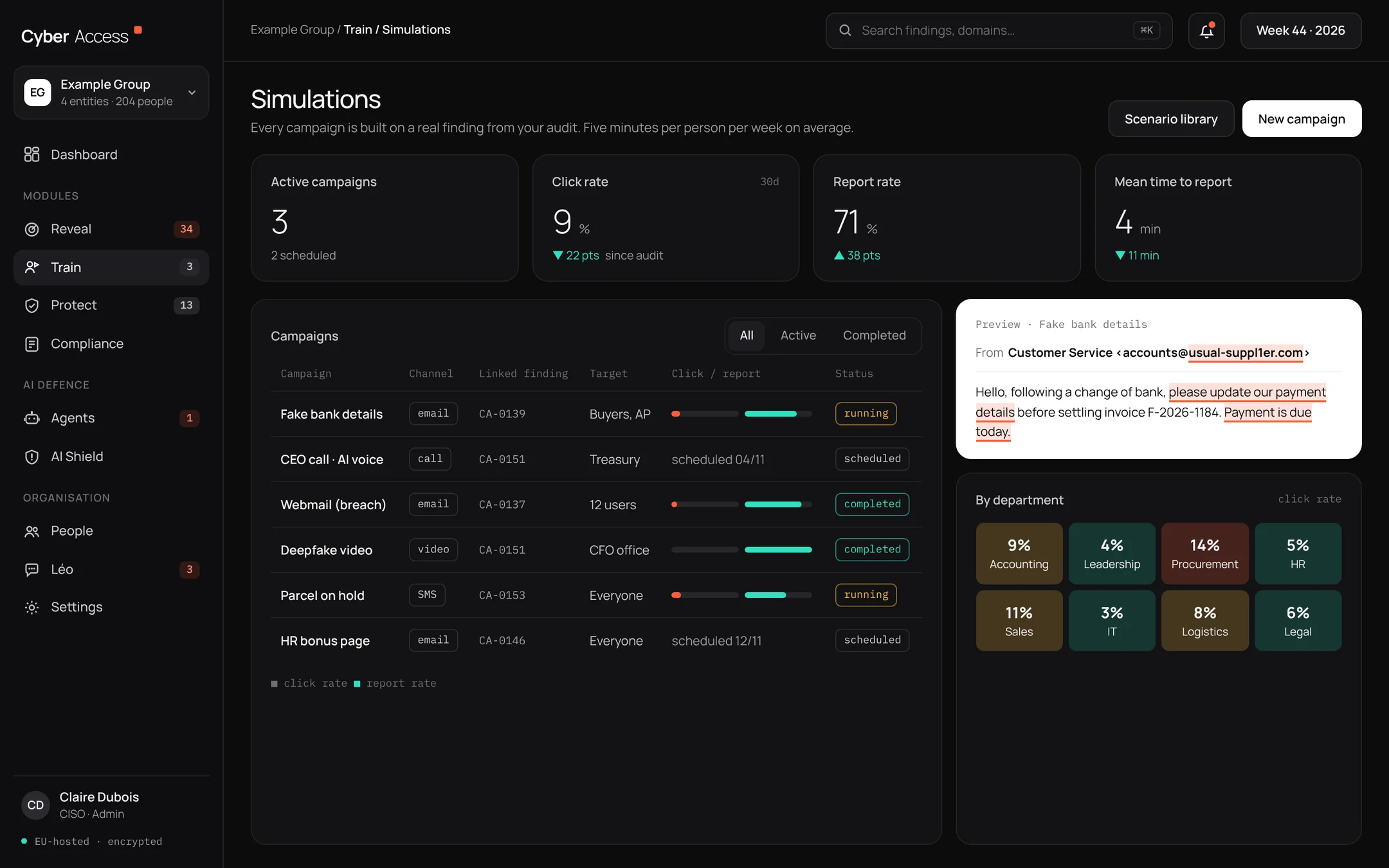
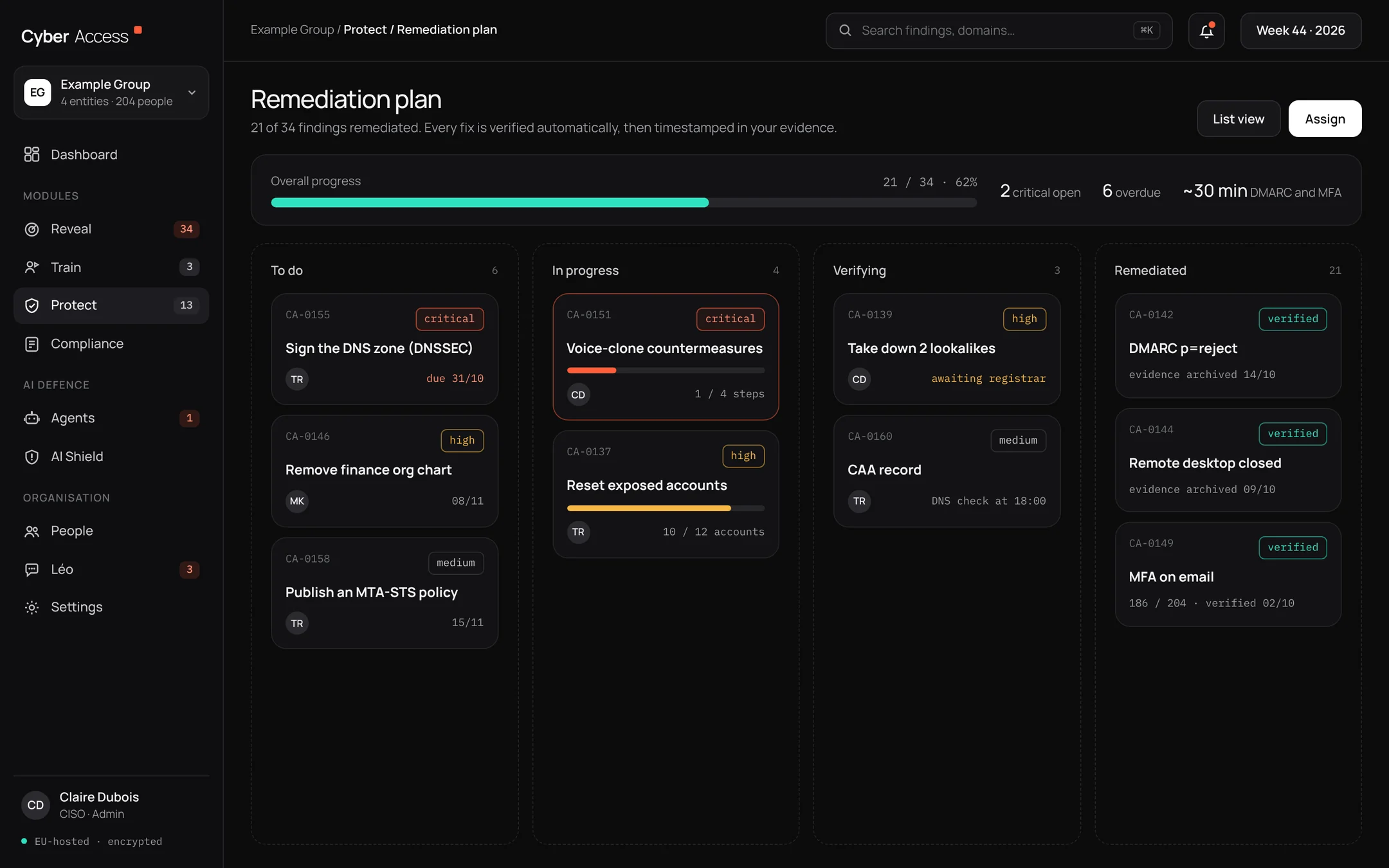
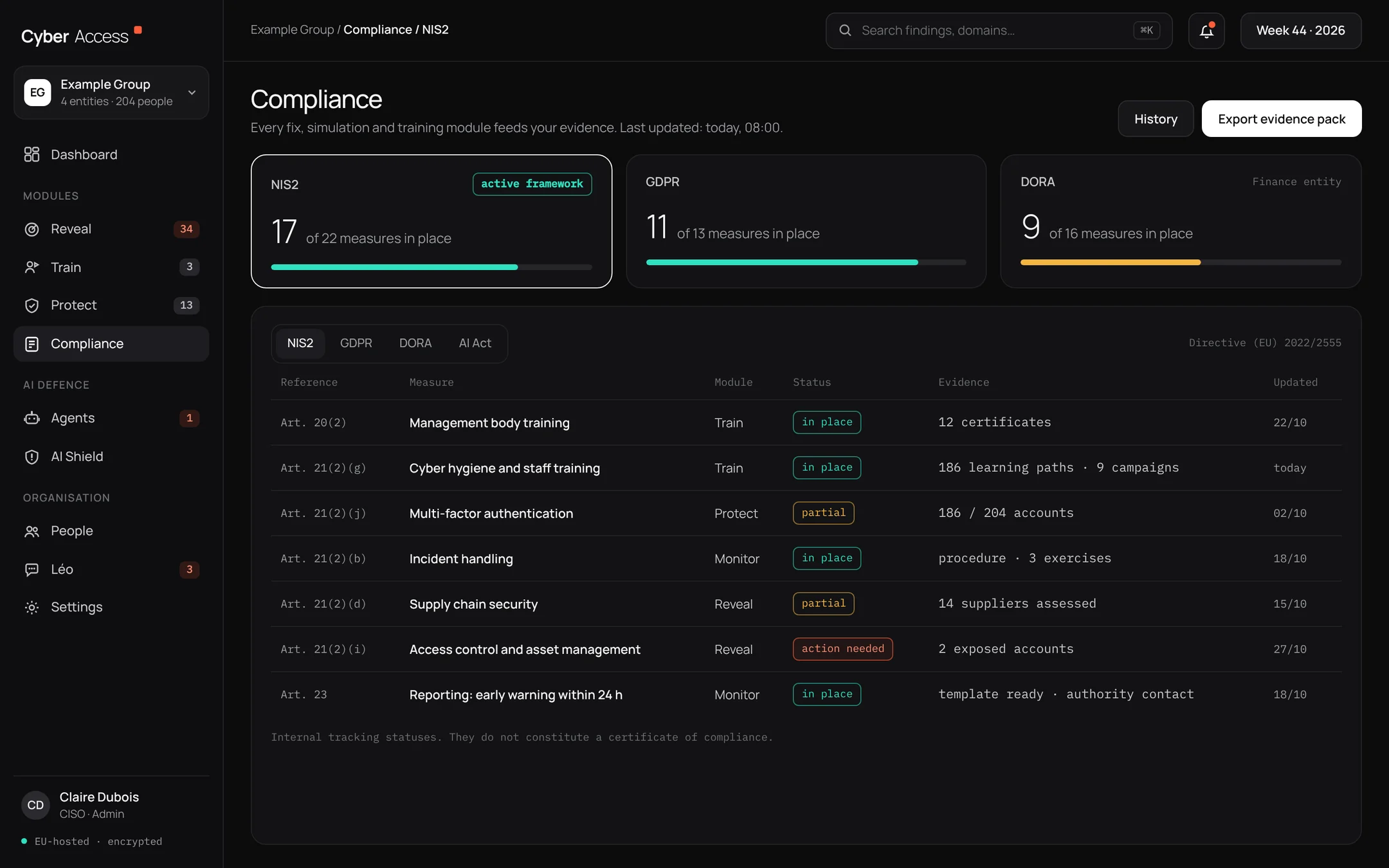
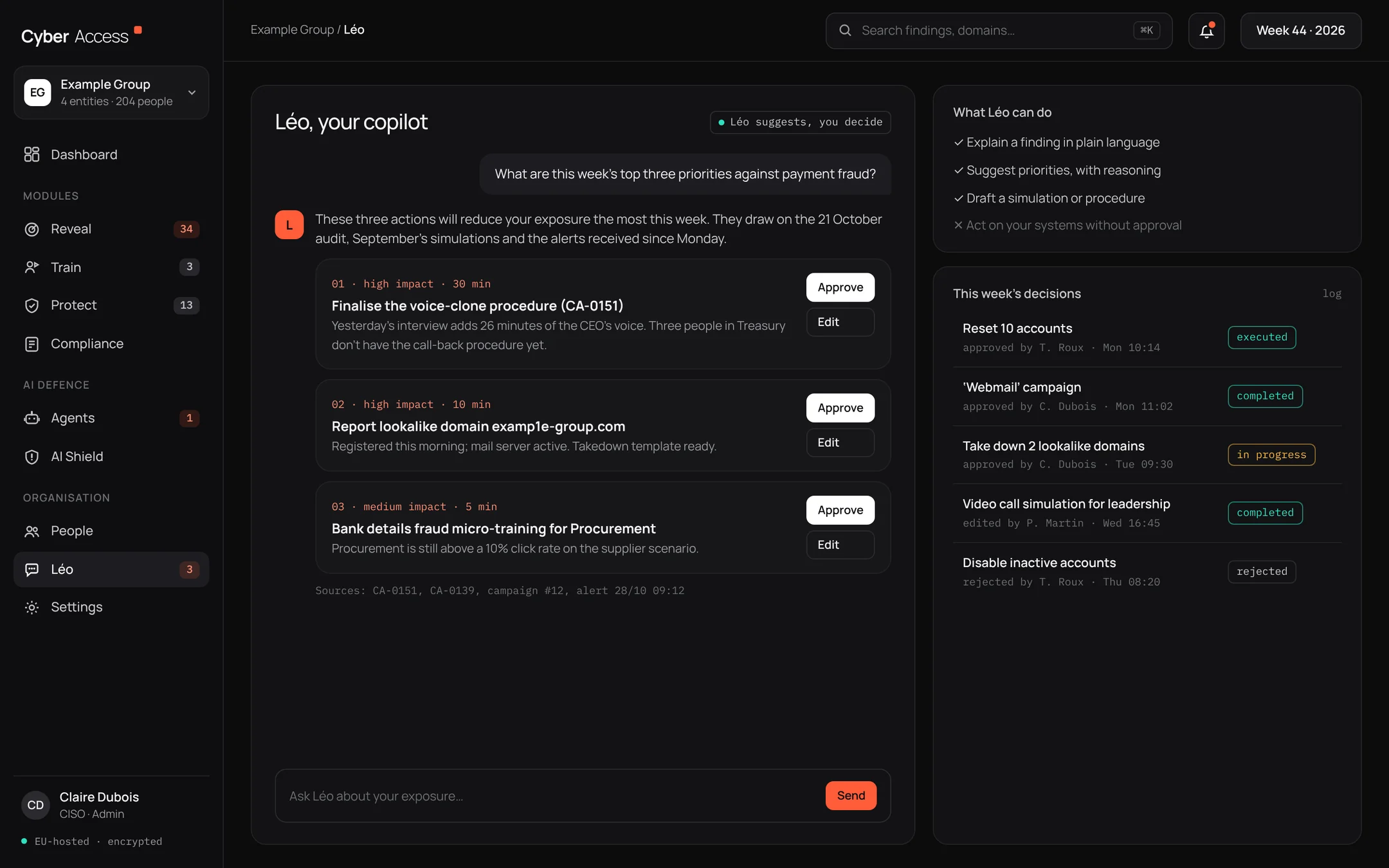
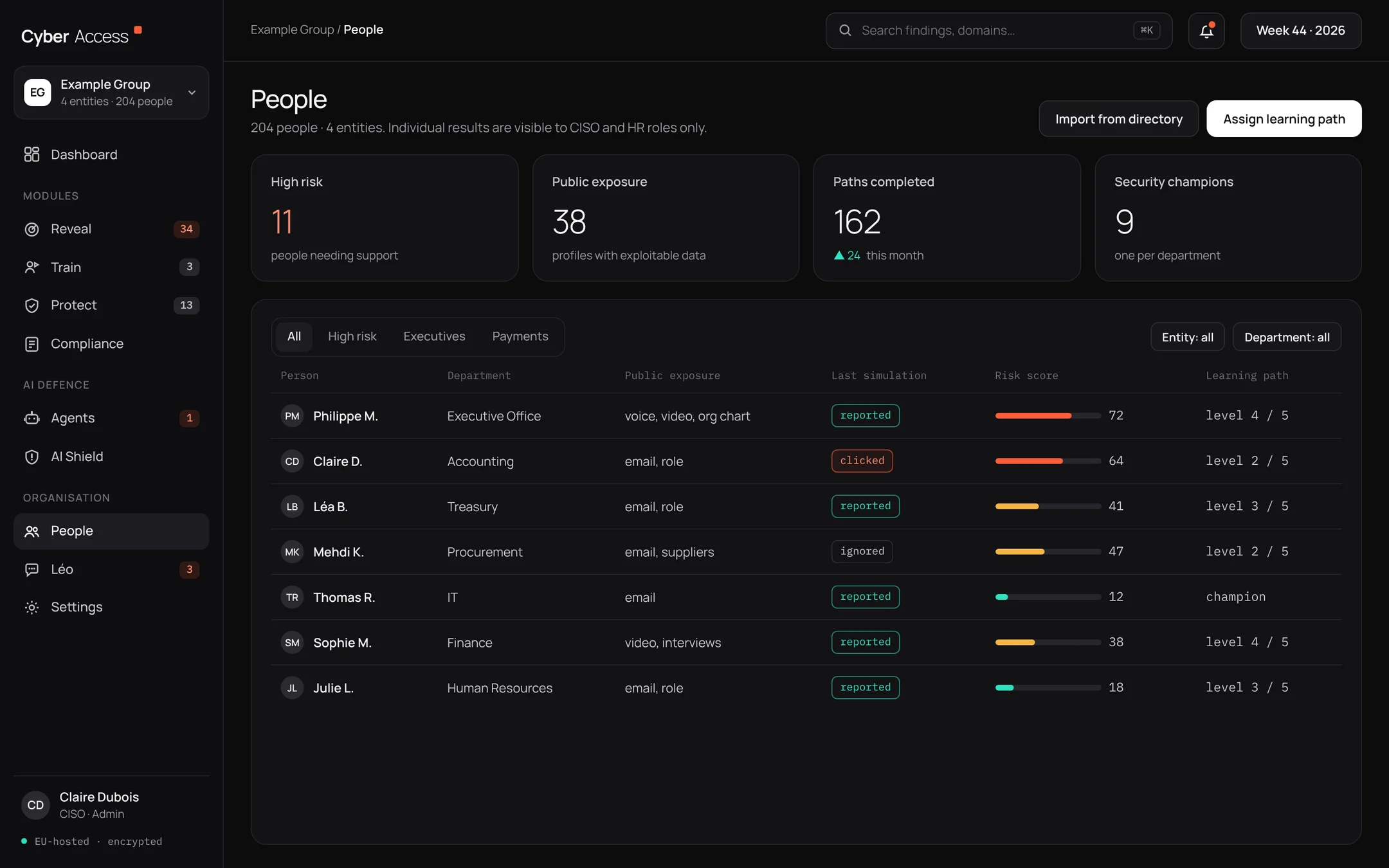
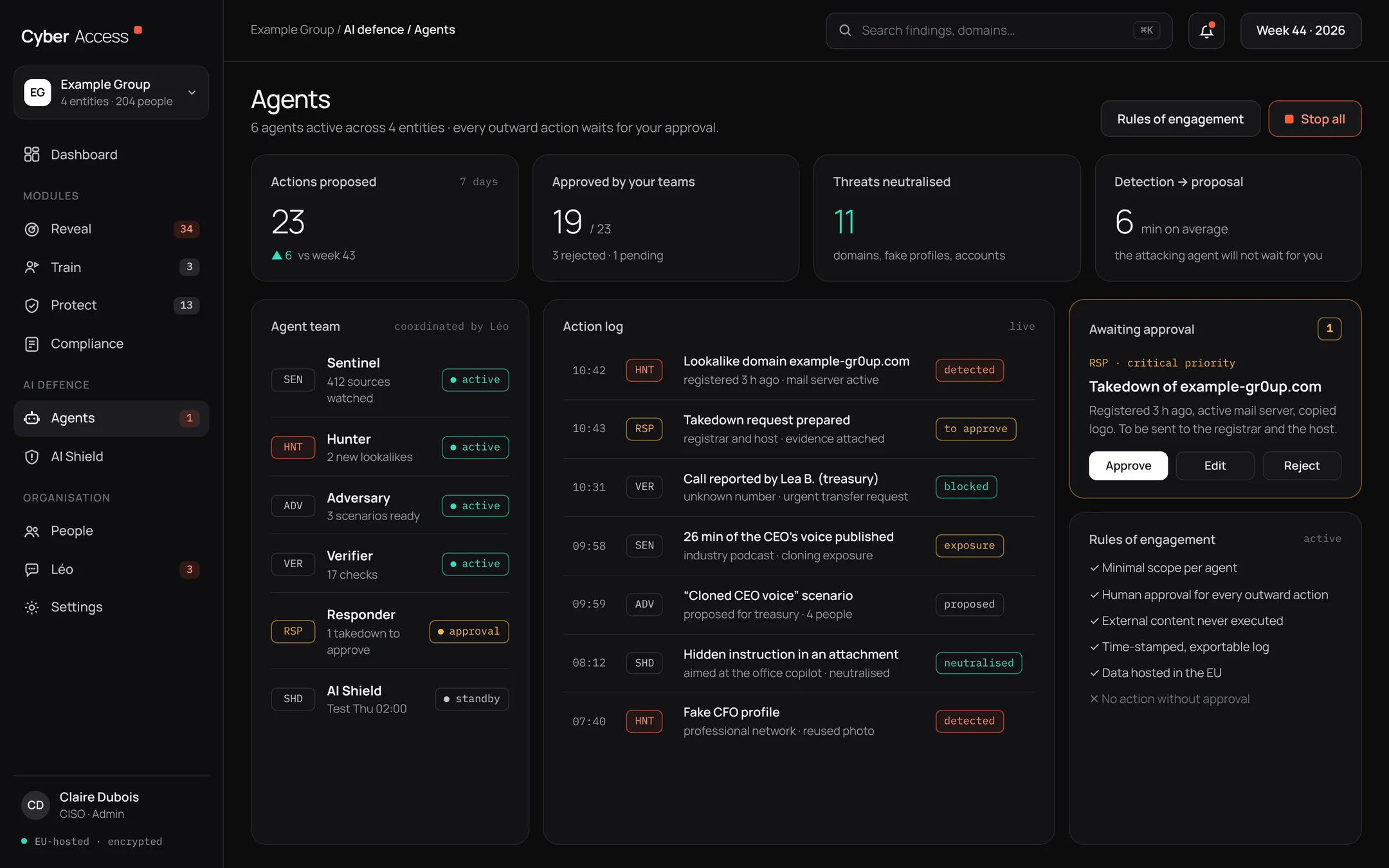
Fictitious organisation and data.
The four modules
Reveal, Train, Protect, Monitor. Use them together or separately.
Reveal
OSINT mapping of your human and technical attack surface: domains, leaked credentials, public exposure of executives.
02Train
Phishing, voice cloning, deepfake and CEO fraud simulations, built from the weaknesses we find.
03Protect
Step-by-step remediation plans: DMARC, multi-factor authentication, DNS hardening, payment procedures.
04Monitor
Risk score, continuous alerts, compliance reports and recommendations from Léo, our copilot.
Typical rollout
From first scan to continuous monitoring, in four weeks.
- Day 1
Scan and scoping
Passive analysis of your domain, a 30-minute call and scope definition: entities, executives, exposed teams.
- Day 2
Exposure report
Within 24 hours, a report of 30 to 50 prioritised weaknesses, each linked to the fraud scenario it enables.
- Week 1
Quick fixes
DMARC, MFA, reset of exposed credentials: high-impact fixes typically take around half an hour each to deploy.
- Week 2
First simulations
The most exposed teams receive simulations modelled on their own weaknesses. Every mistake triggers a micro-lesson.
- Week 4
Monitoring
The dashboard tracks the risk score, progress by department and newly detected exposures.
See what an attacker sees.
More than 30 OSINT tools are orchestrated to reconstruct what a fraudster can find in a few hours: email address formats, organisation chart, suppliers, public voice recordings, lookalike domains, exposed credentials.
- Passive analysis, with no intrusion into your systems
- Prioritised by business impact
- Every weakness linked to a fraud scenario
One simulation for every weakness.
Your people practise on the attacks that actually target them: fake bank details from a real supplier, a call from an executive whose voice is online, an email from a lookalike domain registered last week.
- Difficulty adapted to each person
- Individual risk score
- Around 5 minutes a week
Comparison
What you get, compared with separate approaches.
| Capability | Technical audit only | Generic awareness training | Cyber Access |
|---|---|---|---|
| Mapping of your real exposure | |||
| Simulations based on your weaknesses | |||
| Individual risk score | |||
| Guided and verified remediation | |||
| NIS2, GDPR and DORA compliance evidence | |||
| Continuous monitoring |
CoveredPartially coveredNot covered
Continuous monitoring
Your exposure changes every day. We monitor it continuously.
New lookalike domains, credentials published in a leak, a modified DMARC policy, a new public appearance by an executive: every change is detected, assessed and linked to the fraud scenario it opens up.
Go further
Frequently asked questions
Do we need to install software on our devices?
No. The Reveal phase is entirely passive and relies on public sources. Simulations are delivered by email, SMS or phone call, with no agent to install. Fixes (DMARC, MFA) are made in your existing tools, with our support.
Can we start with a single module?
Yes. Many organisations begin with an exposure audit, then add simulations for their most exposed teams. The modules share the same data, so nothing has to be redone at each stage.
Where is the data hosted?
In the European Union, encrypted in transit and at rest. No data is ever resold. Details are on the trust and security page.
Who decides on the actions Léo recommends?
Always a person. Léo, our copilot, suggests priorities and actions; they are applied only after approval by an authorised person in your organisation.
Conversation with an expert
See your level of exposure. On your own domain.
In 30 minutes: an initial assessment of your weaknesses, the fraud scenarios they make possible, and the plan to close them.