Email and domain
SPF, DKIM, DMARC, MTA-STS, DNSSEC, CAA: can someone send email in your name or hijack your domain?
scenario · CEO fraudModule 01 · Reveal
Before calling your accountant with your CEO's voice, a fraudster spends hours studying you. Reveal does that work first, with more than 30 OSINT tools, and links each weakness to the fraud scenario it makes possible.
What we analyse
SPF, DKIM, DMARC, MTA-STS, DNSSEC, CAA: can someone send email in your name or hijack your domain?
scenario · CEO fraudEmail address formats, key people in finance, procurement and payroll, information published on professional networks.
scenario · spear phishingBusiness email addresses and passwords found in data breaches or in combo lists in circulation.
scenario · account takeoverDomain names close to yours, recently registered, with or without an active mail server.
scenario · bank detail change fraudInternet-facing services: remote access, administration interfaces, certificates issued for your subdomains.
scenario · ransomwareVideos, podcasts, conference talks: the amount of public voice and image material that could be used for cloning.
scenario · voice cloning, deepfake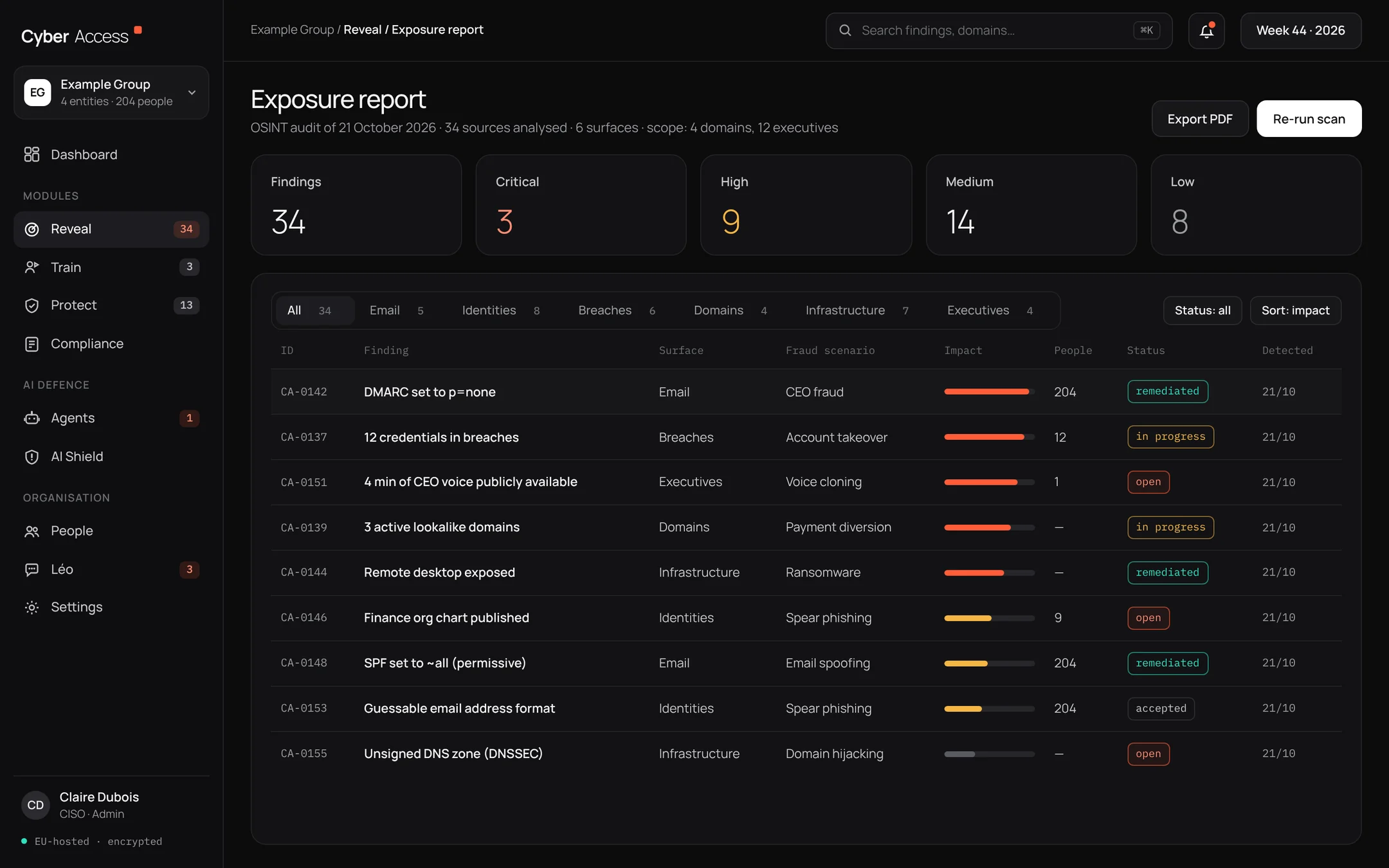
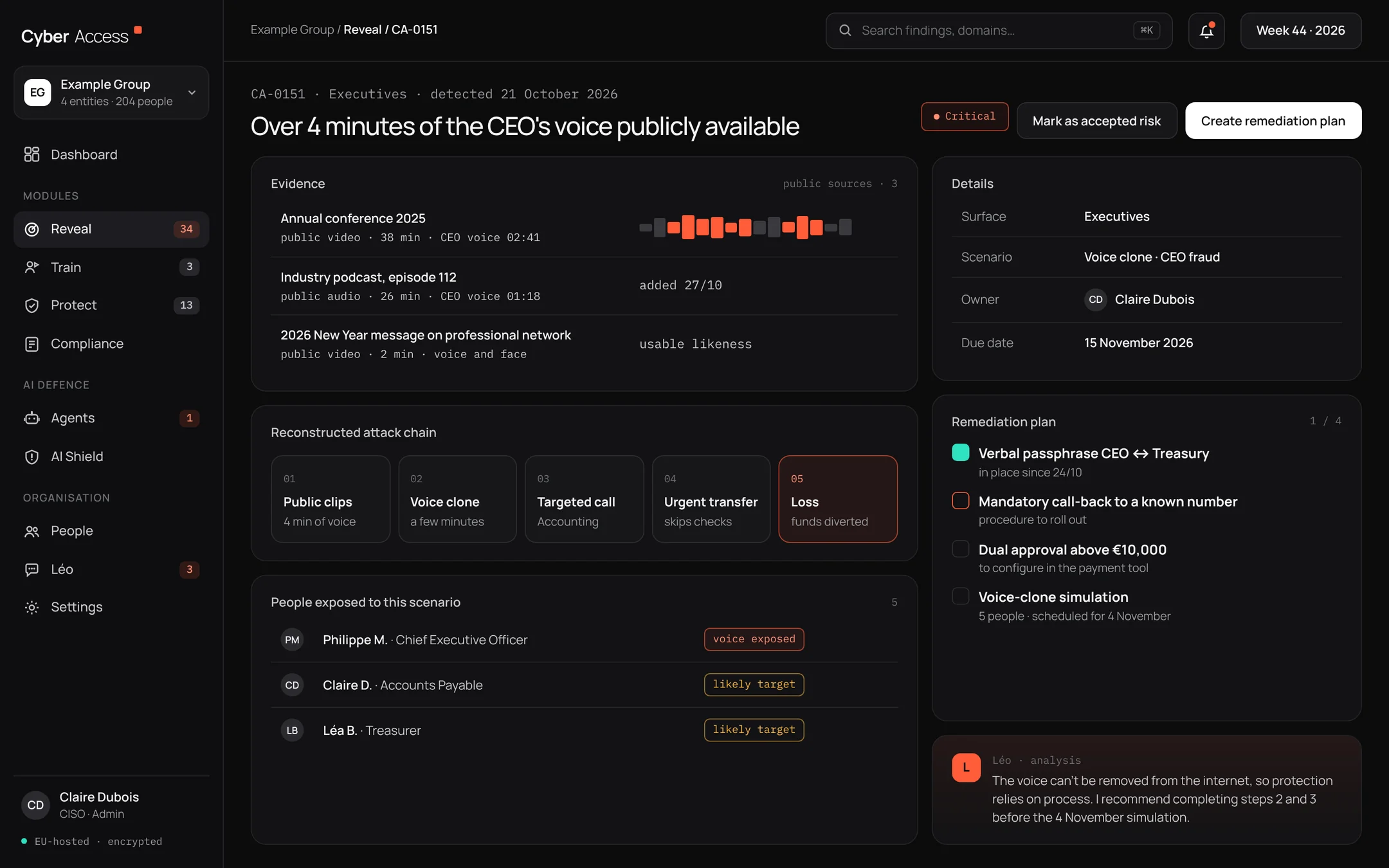
A CVSS score does not tell a CFO what is at stake. Each finding in the report sets out the associated fraud scenario, the people targeted, the business severity and the recommended fix, with its implementation time.
Method
You approve the domains, entities and people analysed. Nothing is collected outside that scope.
Queries to public sources: DNS, registries, certificates, breach databases, search engines, professional networks.
Signals are cross-referenced to reconstruct complete attack scenarios, as a fraudster would.
An analyst checks every finding, removes false positives and sets the priority.
Report within 24 hours and a 30-minute presentation to your teams.
No active testing is carried out on your systems without your written consent. The Reveal phase relies solely on publicly available information.
Yes. It is limited to publicly available information and to a scope you approve. Any personal data encountered (exposed email addresses, for example) is processed on your behalf under a GDPR-compliant contract.
A penetration test actively probes your systems, from the inside or the outside. Reveal maps your public exposure, particularly your human exposure, without any action on your systems. The two are complementary.
The public scan checks in 20 seconds how well your domain is protected against spoofing (SPF, DMARC, DNSSEC, MTA-STS, CAA). The full audit covers the six surfaces described on this page.
With the Monitor module, monitoring is continuous: new breaches, new lookalike domains and configuration changes are flagged as they happen. Without a subscription, a quarterly analysis is a sensible rhythm.
Conversation with an expert
In 30 minutes: an initial assessment of your weaknesses, the fraud scenarios they make possible, and the plan to close them.